If AI Had Existed When Your Workflow Was Designed, Would It Look Like This?
Your team added AI to one step and the work arrives no sooner. The workflow itself is built on old constraints, and that is what needs redesigning.
27 Oct 2026
Your team added AI to the monthly board report, and the drafting is faster now. The report still lands on the same day, after the same chase for figures, the same wait for the finance director and the same round of rework.
This is the common pattern. One step changes and the logic of the work stays where it was. The hour you saved goes into the queue.
Your workflow is a record of old constraints
Every recurring workflow was shaped by what was scarce when someone designed it. Information had to be found and moved by hand, so a person re-types figures from one system into another. Expert judgement was available only at certain points, so the work queues for the expert. Context got lost between teams, so each new team has to be briefed again. Coordination was expensive, so work waits for the weekly batch. Controls were built for a different mix of people and tools, so there is a sign-off at every turn.
Some of those constraints still hold. A legal approval or a safety check is there for a reason, and it stays. Many others exist only because of what the technology could not do at the time.
So ask of each step: if AI had existed when this was designed, would anyone have designed it this way? When the honest answer is no, you have found the work worth changing.
Redesign before you automate
This idea is older than AI. In 1990, Michael Hammer argued in Harvard Business Review that automating an old process mostly makes the old process run faster. His advice was to start from the outcome, look at the whole process end to end, question the order of steps and the hand-offs, and measure success at the outcome rather than at each step.
Factories learned the same lesson. Machines did not pay off as stronger hand tools. They paid off when the layout, the sequence, the skills and the controls were redesigned around them. People stayed essential, but what they contributed changed.
AI is a new kind of building material for that redesign. It can retrieve, meaning find the relevant evidence and bring it into the work. It can generate a draft, an explanation or an option. It can reason in a limited sense: compare, plan and apply criteria you give it. It can remember context from one step to the next, so nobody has to re-brief. Within limits you set, it can act, such as updating a record. Each of these works well under some conditions and poorly under others, so design the flow first and then choose the material for each step.
Change the order, not just the speed
Five redesign moves do most of the work. Eliminate steps that no longer create value, such as re-typing data. Combine steps when context can be carried through, such as searching and drafting together. Reorder, so evidence arrives at the start instead of at review. Run checks in parallel when they do not depend on each other. Route exceptions, so routine cases flow straight through and the expert only sees cases that need judgement.
Eliminating is about steps, not people. Applied to the board report, the moves produce a different flow.

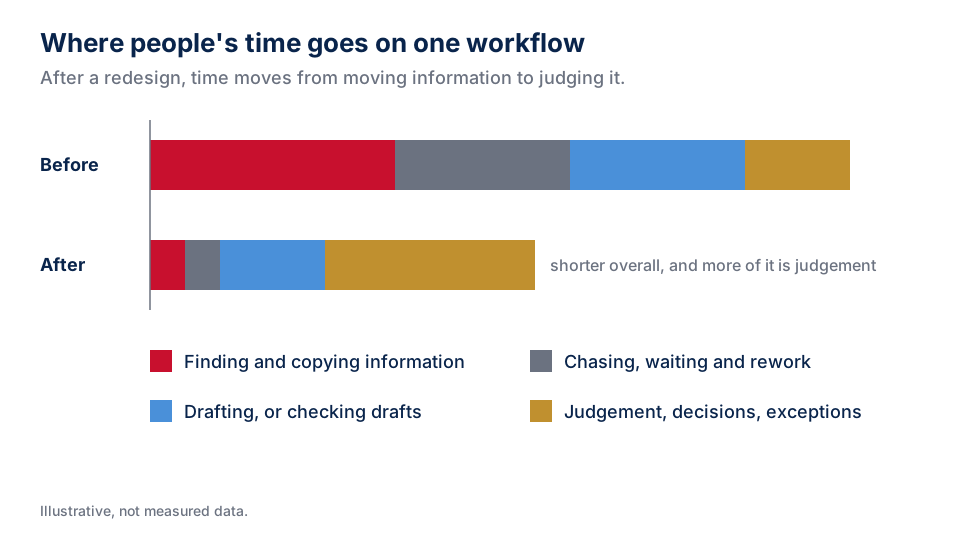
The evidence now comes first, so the draft is built on it rather than checked against it later. The chase and the copying disappear. The finance team stops reviewing every line and looks only at figures that do not reconcile or need explaining. The finance director still owns what goes to the board.
The bigger change is where people spend their time.
Being able to do something is not permission to do it
Once AI does real steps, someone has to decide what it is allowed to do. I find three zones enough for most workflows. In the act zone, AI may proceed within stated limits, such as gathering figures from approved sources. In the approve zone, AI prepares and a named person decides, such as signing off the commentary before it reaches the board. In the stop zone, a case falls outside the limits and the work stops and goes to a named owner, such as a figure that does not match the ledger.
This is governance, and it belongs inside the workflow. A policy written after the redesign cannot see the hand-offs it is meant to control. Ownership, measurement and the response when something goes wrong are part of the design, drawn on the same page as the steps.
Test the workflow, not the demo
A demo shows one good answer. A pilot should show whether the new flow creates value, safely, again and again. Run it on routine cases, awkward cases and cases designed to fail. Watch the outcome, how reliable it is, whether people actually use it and how much effort it takes to run. Then make one of four decisions: expand, adapt, pause or stop.
On Monday, pick one recurring workflow your team runs every month. Write down what starts it and what it should produce. List each step, and next to it write the constraint that created it. Cross out every constraint that no longer holds, and redraw the flow without it.
Want to go further? Tomorrow's free lesson takes one workflow from your organisation and redraws it live, using the moves and authority zones above.
Free lesson, tomorrow, Wednesday 28 October, 7pm London, 30 minutes: Stop Adding AI to Old Workflows.
AI Transformation for Organisational Leaders is an eight-session live cohort I teach with Anoosh Zeighami, starting Wednesday 4 November. You leave with a one-page 2027 AI plan for your organisation.
AI Transformation for Organisational Leaders
For directors, heads of function and founders: eight live evening sessions with Ehsan Gazar and Anoosh Zeighami, ending with a one-page 2027 AI plan for your organisation, built on a real workflow and ready for your leadership team.
$1,495, or $1,045 with code EARLYBIRD until 23 Oct.
View the live cohortKeep reading
- AI Transformation Is Not Digital Transformation With a New Tool
- Your AI Pilot Saved Time. Why Didn't the Business Change?
- A Chatbot Answers. An Agent Does the Work. Here Is the Difference
- Why AI Can Crack a 90-Year-Old Maths Problem and Still Get Your Invoice Wrong
- I Use AI Every Day: Why I Built a Place to Practise the Old Problems
- How I Find Problems Worth Solving