Your 2027 AI Plan Should Fit on One Page: Six Questions to Answer First
Most AI roadmaps are a list of projects nobody can decide on. A plan worth funding answers six linked questions on one page.
3 Nov 2026

Your 2027 AI plan is probably a list: a pilot, some licences, a proof of concept, a dashboard, a training day. Each item sounds sensible, and together they do not ask anyone to decide anything.
That is why so many AI plans get nodded through and then quietly stall. Nobody can say what the money is meant to change, so nobody can tell whether it worked.
A plan is an argument, not a list
Try a simple test. Cross out one item on your list, say the dashboard. If nothing else in the plan breaks, nobody really knew why it was there.
A plan worth funding works the other way round. It is an argument with four parts: what we are asking for now, why it matters, how the work will change, and what evidence will shape the next decision. Each reason holds up the request. Take one away and the request falls over, which is exactly what you want, because it means every part is doing a job.
Six questions make the argument
In the course, Anoosh and I call this the Vatan AI Transformation Decision Map. It is six questions, answered in order, and the answers fit on one page:
- Value: what should become better, and for whom?
- System: where is that value created, and what is holding it back?
- Move: what will we do now, and what will we deliberately leave for later?
- Work: how will the work, and the authority to decide, change?
- Change: what in the organisation must line up, and who must work differently?
- Evidence: what are we committing to now, and what is the next decision?
Value is the hardest to write well. Name the customer, mission or financial outcome, the pain behind it, how AI might help, and where your claim stops.
System is where most plans skip a step. Think of a restaurant kitchen. A faster chef does not get more plates out if the bottleneck is the pass, where every dish waits for the head chef to check it. Find your pass before you buy a faster chef.
Move is about saying no. Every good plan names an attractive idea it is putting off, and the foundation the chosen move depends on.
Work is about who does what. Which steps does AI prepare, which does a person approve, and when must everything stop? One named person owns the whole flow.
Change is about people. I wrote about this in why a working AI system can still go unused: a launch is not adoption, and someone specific has to work differently.
Evidence closes the loop. It names what you are committing to now, the date you will look again, and four signals to read on that date: did the outcome improve, was it reliable, did people use it, and how much effort did it take to run?
Each answer has to hold up the next
The six answers are not six boxes to fill. They are a chain, and a chain breaks at its weakest link.

So test it link by link. Does the system answer explain where the value can be created? Does the move tackle the bottleneck you named? Does the new way of working make the value possible? Does the change plan support the behaviour that new work needs? Will the evidence actually guide the next commitment?
When one answer does not support the next, fix that one first. A polished page with a broken link in the middle is a confident plan for the wrong thing.
Ninety days should buy learning, not a launch
The plan does not ask for a year of budget. It asks for a bounded first commitment, and I use ninety days.
Those ninety days move through four stages. First, establish the owner, the scope and who has access. Then prepare the workflow, the safety checks and the support people will need. Then run a contained trial in real work. Finally, review what happened and make the next decision on that evidence.
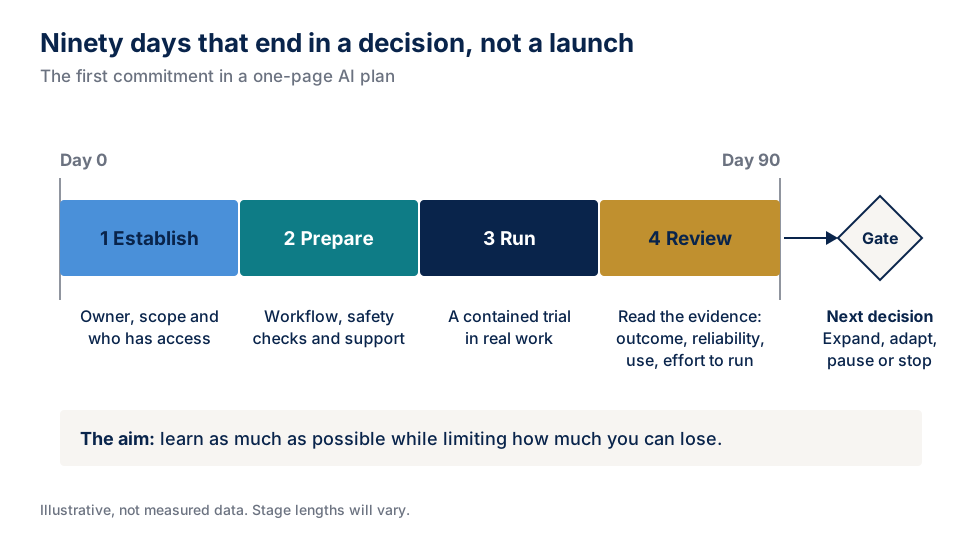
The aim is to learn as much as possible while limiting how much you can lose. A ninety-day commitment that ends in "expand", "adapt", "pause" or "stop" is a success, whichever word it is, as long as the evidence chose it.
New evidence should change the plan
Plans that never change are usually plans nobody is reading. Suppose you find that reviewing the AI's work takes twice the time you expected. Or the quality is fine but people still do not use it. Or a data source you depended on is going to arrive late.
Each of those should move a specific answer on the page, and possibly the commitment with it. That is not failure. That is the plan doing its job. The page is finished when it produces a decision, not when every box is full.
Write six sentences before you write anything else
On Monday, write one sentence for each of the six questions about your own biggest AI initiative. Read them top to bottom and mark the sentence that does not follow from the one above. Then write three more lines: the decision you are asking for, the person who can make it, and the date you will review it.
Want to go further? Session 8 of the cohort is where every earlier session comes together into this one-page map, tested and defended in a live leadership lab.
Both free lessons have recordings on Maven: watch the free lesson replay of "Stop Adding AI to Old Workflows".
Last call: enrolment closes tomorrow, Wednesday 4 November, at 7pm London. AI Transformation for Organisational Leaders is an eight-session live cohort I teach with Anoosh Zeighami, starting Wednesday 4 November. You leave with a one-page 2027 AI plan for your organisation.
AI Transformation for Organisational Leaders
For directors, heads of function and founders: eight live evening sessions with Ehsan Gazar and Anoosh Zeighami, ending with a one-page 2027 AI plan for your organisation, built on a real workflow and ready for your leadership team.
$1,495, or $1,045 with code EARLYBIRD until 23 Oct.
View the live cohortKeep reading
- The AI System Works. So Why Is Nobody Using It?
- If AI Had Existed When Your Workflow Was Designed, Would It Look Like This?
- AI Transformation Is Not Digital Transformation With a New Tool
- Your AI Pilot Saved Time. Why Didn't the Business Change?
- A Chatbot Answers. An Agent Does the Work. Here Is the Difference
- Why AI Can Crack a 90-Year-Old Maths Problem and Still Get Your Invoice Wrong