The AI System Works. So Why Is Nobody Using It?
Your AI tool passed every test, yet people still work the old way. Adoption is a change in behaviour, and it has to be led like one.
29 Oct 2026

Your team launched the AI workflow, and it passed its quality checks. Months later, most people still do the work the old way.
Nothing is wrong with the software. What failed is the change around it, and that is a leadership problem, not a technical one.
A working system is not proof that anything changed
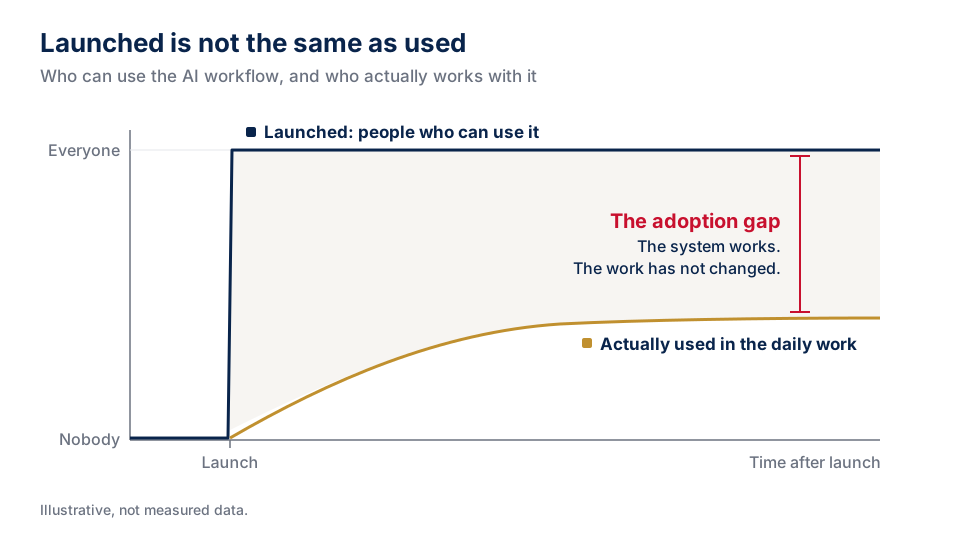
A launch tells you the tool exists. It does not tell you that anyone works differently.
You have probably seen the pattern. The workflow hits its quality target in testing. Staff try it, find it slower than the habit they trust, and drift back. Their managers still judge them on the old measures, so nobody objects. The dashboard says "live". The work says otherwise.
I keep two separate scores. The first is technical performance: does the system do the job? The second is adoption: does the organisation now do the job with it? You can score high on the first and low on the second. Stalled AI projects live in that gap.
Adoption means a named person behaves differently
"Get people using the tool" is too vague to manage. Four questions make it concrete.
Who must behave differently? What must they start, stop or do differently? What condition makes that new behaviour possible? And what outcome should follow?
A good answer names a role and an action. "Claims handlers check the AI's draft against the evidence before they approve it" is a behaviour you can see, support and count. "Embrace AI" is not.
The old way survives because something still rewards it
When people return to the old way, it is rarely stubbornness. Something in the organisation still makes the old way the sensible choice.
The McKinsey 7S model is a useful checklist here. It says an organisation has seven parts that must fit together: strategy, structure, systems, shared values, style, staff and skills. Change one, and you usually have to adjust the others.
Take a reviewer who skips the evidence check on AI drafts. The cause might be a target that rewards volume over careful decisions; that is a systems problem. They might carry the blame for errors with no authority to stop a case, which is structure. There may be no time in the week to review properly, which is staffing. Or their manager may not like hearing bad news, which is style. More training fixes none of these. Changing the condition does.
Movement needs a sequence, not a launch email
7S shows you where things do not fit. It does not tell you what to do first. For the order, I use John Kotter's eight steps for leading change. They run from creating urgency and building a guiding group, through removing barriers and showing early wins, to making the new way stick. I cover them in more depth in Kotter's 8-step playbook.
You do not need to memorise the list. The point is that people move when the reason is real, when people with authority and credibility back it, and when the affected staff help shape the new workflow instead of receiving it.
In our course, Anoosh and I join the two models into one cycle called CHANGE, with four stages. Align fixes the conditions that keep the old behaviour alive; this is where 7S does its work. Mobilise creates urgency, a guiding group and real participation, which are Kotter's first four steps. Enable removes the barriers that stop people doing the new work well. Embed and learn turns early wins into habit, then feeds what you learned back into the next round.

One warning. Neither model redesigns the work itself. The cycle helps you lead people into a workflow that is worth adopting; it cannot make a poor workflow worth it.
A quick win must be easy enough and meaningful enough
The first win carries more weight than it looks. A polished demo is easy to produce, but it proves little. A large transformation matters, but it will not show results in weeks.
A credible quick win sits between the two. It solves a problem people already complain about. Its scope is small, so it does not depend on ten other teams. The result is possible in weeks, not years, and the people who matter can see the improvement. You can observe its value, its use and its risk, and it teaches you something you need for the next decision.
Then judge it in five parts, not one. Can people reach the workflow? Do the cases that should go through it actually go through it? Is the new behaviour done properly? Did it create the value you expected? And on that evidence, do you expand, adapt, pause or stop? A win should end in a decision, not in a celebration slide.
Start with one sentence and three conversations
On Monday, pick one AI workflow your organisation has already launched. Write one sentence naming who should now work differently, and how. Then ask three of those people what still makes the old way easier. Their answers are the first draft of your change plan.
Want to go further? Session 7 of the cohort is about exactly this gap: turning a system that works into work that has changed, with a change plan and a first credible win.
Both free lessons have recordings on Maven: watch the free lesson replay of "Stop Adding AI to Old Workflows".
AI Transformation for Organisational Leaders is an eight-session live cohort I teach with Anoosh Zeighami, starting Wednesday 4 November. You leave with a one-page 2027 AI plan for your organisation.
AI Transformation for Organisational Leaders
For directors, heads of function and founders: eight live evening sessions with Ehsan Gazar and Anoosh Zeighami, ending with a one-page 2027 AI plan for your organisation, built on a real workflow and ready for your leadership team.
$1,495, or $1,045 with code EARLYBIRD until 23 Oct.
View the live cohortKeep reading
- If AI Had Existed When Your Workflow Was Designed, Would It Look Like This?
- AI Transformation Is Not Digital Transformation With a New Tool
- Your AI Pilot Saved Time. Why Didn't the Business Change?
- A Chatbot Answers. An Agent Does the Work. Here Is the Difference
- Why AI Can Crack a 90-Year-Old Maths Problem and Still Get Your Invoice Wrong
- I Use AI Every Day: Why I Built a Place to Practise the Old Problems