AI Transformation Is Not Digital Transformation With a New Tool
Your AI plan looks like your last digital programme: a tool, a rollout, a go-live date. What carries over, what breaks, and what to run instead.
23 Oct 2026

Your AI plan probably looks like your last digital programme. A vendor, a rollout, a training budget and a go-live date. That plan can deliver the tool on time and still miss the change you were paying for.
Digital transformation taught leaders a great deal, and most of it still holds. The mistake is assuming all of it holds. AI changes something digital tools never touched: who, or what, does the thinking.
Each wave moves the change closer to judgement
Think of four kinds of change as a ladder. Digitisation turns paper into files. Digitalisation runs a process on connected systems, so an order moves without anyone carrying it. Digital transformation changes how the organisation creates value, such as a shop becoming an online marketplace. AI transformation reorganises knowledge work, judgement and action around what AI can now do.
The first three changed how information moved between people. The fourth reaches into the work those people do with it: reading, weighing, deciding, drafting and acting.
That is why a software rollout plan is the wrong shape. A rollout assumes the tool behaves the same on day ninety as on day one, and that the people around it keep the same jobs. Neither is true here.
Five lessons carry over intact
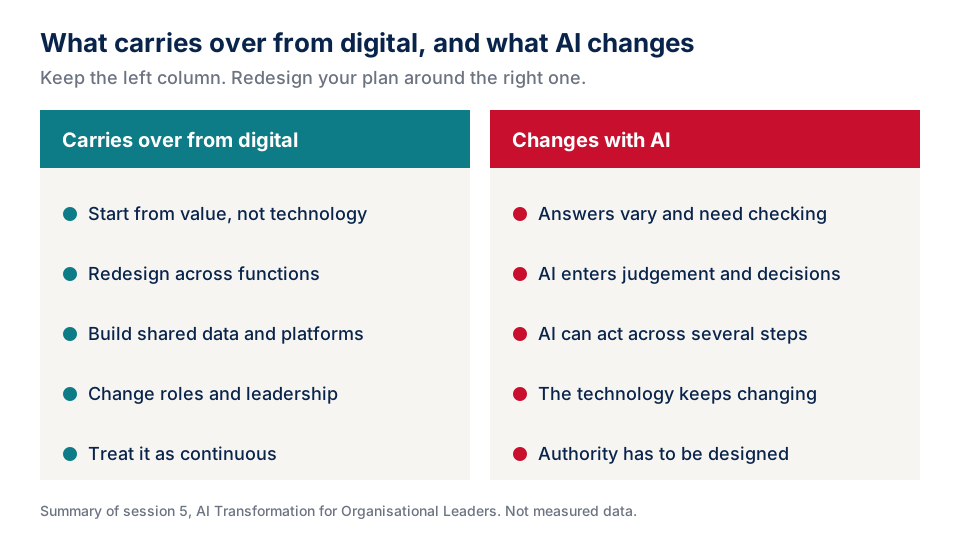
Much of what your organisation learned the hard way is still right. Start from the value you want, not the technology you bought. Redesign across functions, because the delay usually lives in the hand-off between teams, not inside one team. Build shared foundations: clean data, common platforms and a steady operating rhythm. Change roles and leadership behaviour, not just software. Treat the whole effort as continuous, not a programme with an end date.
If your digital programme got these right, you start ahead. If it skipped them, AI will expose the gap.
Five assumptions break
The first is that output is predictable. A spreadsheet formula gives the same answer every time. AI gives an answer that is usually good and sometimes wrong, so someone has to judge it in context, the way you would check a capable new hire's first reports.
The second is that technology stays out of judgement. AI now drafts the recommendation, compares the options and flags the risk. That is thinking work, and until recently only people did it.
The third is that systems only respond. Newer AI tools can carry out a series of steps on their own, such as looking something up, filling in a form and sending it. Anything that can act needs limits.
The fourth is that the tool stands still after go-live. The models, the companies that supply them and the way they behave keep changing under you.
The fifth follows from the other four. Authority and oversight cannot live in a policy document written afterwards. You have to design who may act, who must approve and when the work stops.
Use each model for the question it answers
It is tempting to pick one transformation framework and defend it. I think that is the wrong move. Three well-known ones each answer a different question.
One, from Matt, Hess and Benlian, is a checklist of what a strategy must cover: the technology, how value is created, the structure and the money. Another, from Gregory Vial, explains how the change unfolds, from a disruption through your response to new ways of creating value. The third is Dynamic Capabilities, from David Teece's work, which asks how an organisation keeps renewing itself. In plain words: notice what is changing, commit resources to a bet, reshape the work, and repeat.
Use the first two as checks. Use the third to steer. AI keeps moving, you have to choose before the evidence is complete, and value only arrives when the work and the organisation change around the tool. A model built for repeated renewal fits that.
Run a loop, not a programme
The steering model has three verbs: sense, seize and transform. In practice they become six management actions, and the last one feeds back into the first.

Setting direction means naming the customer, mission or financial result that matters. Seeing the system means finding where in your chain of work AI could change that result, and what the real bottleneck is today. Choosing the moves means deciding what each bet is for: improving today, building foundations or exploring tomorrow. Sequencing puts those bets into now, next and later.
Starting small means one bounded test that produces evidence. Redesigning and scaling means changing the work itself, not just adding the tool, and then going back to sensing with what you learned.
The real difference from a programme is the exit. Every test ends in one of four decisions: expand, adapt, pause or stop. A programme only knows how to continue.
Begin with one bounded commitment
Your roadmap should not open with a portfolio of ten initiatives. It should open with one commitment small enough to finish and specific enough to teach you something. Ten aspirations produce ten status reports; one bounded move produces evidence.
On Monday, open your current AI plan and find the go-live date. Next to it, write the evidence that would make you expand, adapt, pause or stop. If you cannot write that line, you have a rollout plan, not a transformation plan.
Want to go further? The next free lesson takes the "redesign the work" step of this loop and applies it to one real workflow.
Free lesson, Wednesday 28 October, 7pm London, 30 minutes: Stop Adding AI to Old Workflows.
AI Transformation for Organisational Leaders is an eight-session live cohort I teach with Anoosh Zeighami, starting Wednesday 4 November. You leave with a one-page 2027 AI plan for your organisation. Today, Friday 23 October, is the last day of the EARLYBIRD code: $1,045 instead of $1,495.
AI Transformation for Organisational Leaders
For directors, heads of function and founders: eight live evening sessions with Ehsan Gazar and Anoosh Zeighami, ending with a one-page 2027 AI plan for your organisation, built on a real workflow and ready for your leadership team.
$1,495, or $1,045 with code EARLYBIRD until 23 Oct.
View the live cohortKeep reading
- Your AI Pilot Saved Time. Why Didn't the Business Change?
- A Chatbot Answers. An Agent Does the Work. Here Is the Difference
- Why AI Can Crack a 90-Year-Old Maths Problem and Still Get Your Invoice Wrong
- I Use AI Every Day: Why I Built a Place to Practise the Old Problems
- How I Find Problems Worth Solving
- Notes on Software Quality