Your AI Pilot Saved Time. Why Didn't the Business Change?
Your AI pilot made one step faster, but the results did not move. The cause is usually the slowest step, and what you did with the time.
20 Oct 2026

The pilot report looks great. Drafting proposals now takes a fraction of the time, and the team likes the tool. Yet deals close no faster, nobody feels less busy, and the numbers the board watches have not moved.
When this happens, it is rarely the tool's fault. The problem is where the tool was put, and what happened to the time it saved.
Your business is a chain, not a list of tasks
Every promise you make to a customer is delivered by a chain of activities. A request arrives. Someone gathers information, someone drafts, someone reviews and approves, someone delivers. The output of one step is the input of the next.
Strategy writers call this the value chain: the sequence of activities through which a business creates what the customer pays for. You do not need the theory. You need the picture.

The slowest step sets the pace
Think of a restaurant kitchen. If the chef chops twice as fast but there is only one oven, dinner does not arrive any sooner. The vegetables just wait longer next to the oven.
Much knowledge work behaves the same way. Often the longest part is not the work itself but the wait between steps: for a review, a sign-off, a missing document. Speed up one step, and the work simply reaches that queue sooner.
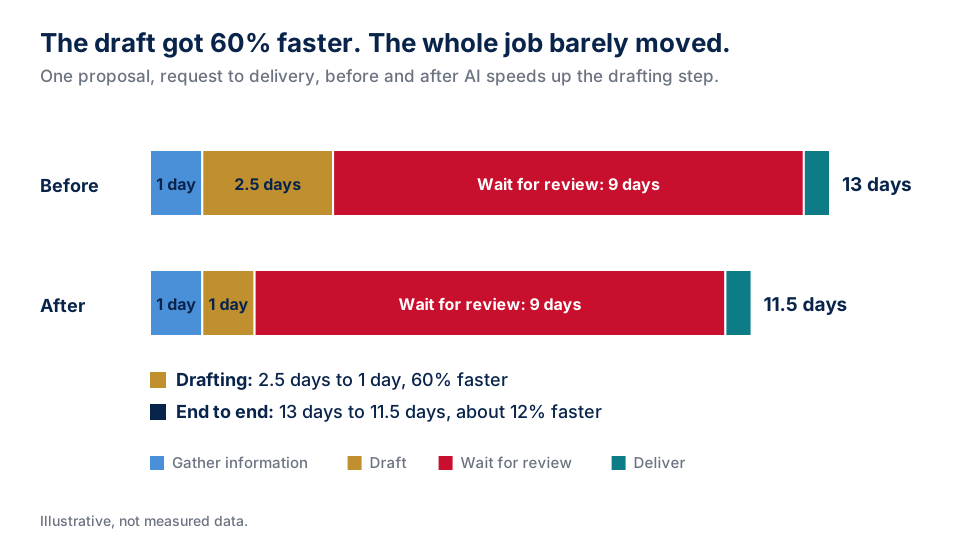
The numbers in that chart are illustrative, but the arithmetic is not. If drafting was two and a half days of a thirteen-day process, making it 60% faster saves a day and a half at most. The nine days of waiting for review are still there.
It can be worse than flat. A faster step can overload the next one. More drafts landing on a reviewer who was already the bottleneck is not progress. It is a longer queue.
Saved time is not saved money
Even when the hours are real, they are released capacity: time that has been freed up but not yet put to any use. It becomes value only when a manager decides what it is for.
There are only a few real options. Lower your price. Keep the price and take a better margin. Give better service. Handle more volume. Offer something new. Each needs a decision, and often a change elsewhere in the chain. If nobody decides, the hours quietly dissolve into longer meetings and fuller inboxes.
Creating value is not the same as keeping it
There is a second trap. Value creation is the gap between what a customer would pay and what it really costs you to deliver. Value capture is the share of that gap your organisation keeps.
AI can create value you never keep. Your competitors can buy the same tools. A pure efficiency gain soon becomes the industry's new normal, and the benefit drifts to customers through lower prices. A cheaper step inside your business can also push work or risk onto someone else, such as a supplier, a partner or the customer. That cost tends to come back later.
Measure the end, not the step
The fix starts with what you measure. Do not judge an AI change by how much faster one activity became. Judge it by the end outcome for the customer, and the total resources the whole chain used to get there.
That also changes where you put AI in the first place. Find the slowest step first. Then ask whether AI can help there, or whether that step should be redesigned or removed. Sometimes the answer has nothing to do with AI. A review that waits nine days may need a second reviewer, a clearer threshold, or no review at all for low-risk cases.
A pilot that speeds up one step but leaves the end outcome flat has still taught you something useful. It has told you the constraint is somewhere else.
On Monday, take your most successful AI pilot and draw its chain on a whiteboard. Under each step, write how long work waits before that step starts. Circle the longest wait. Then ask the team one question: what did we decide to do with the time we saved?
Want to go further? Before you redesign a chain around AI, you need to know which of its outputs you can trust to move along it, and that is where the free lesson starts.
Join the free 30-minute lesson tomorrow, For Leaders: How Can AI Solve a Millennium Problem Yet Fail?, on Wednesday 21 October at 7pm London.
AI Transformation for Organisational Leaders is an eight-session live cohort I teach with Anoosh Zeighami, starting Wednesday 4 November. You leave with a one-page 2027 AI plan for your organisation. Use code EARLYBIRD to pay $1,045 instead of $1,495, until Friday 23 October.
AI Transformation for Organisational Leaders
For directors, heads of function and founders: eight live evening sessions with Ehsan Gazar and Anoosh Zeighami, ending with a one-page 2027 AI plan for your organisation, built on a real workflow and ready for your leadership team.
$1,495, or $1,045 with code EARLYBIRD until 23 Oct.
View the live cohortKeep reading
- A Chatbot Answers. An Agent Does the Work. Here Is the Difference
- Why AI Can Crack a 90-Year-Old Maths Problem and Still Get Your Invoice Wrong
- I Use AI Every Day: Why I Built a Place to Practise the Old Problems
- How I Find Problems Worth Solving
- Notes on Software Quality
- I Built a Tool to Compare Senior Engineer Salaries Across 17 Cities, and I Want Your Take