A Chatbot Answers. An Agent Does the Work. Here Is the Difference
Vendors call everything an agent. Here is what each step from chatbot to agent adds, and how much supervision each one needs from you.
15 Oct 2026

Your team asks a chatbot to draft a reply to a customer who has not paid. It does, in seconds. Then a person still has to find the contract, check the amount owed, send the email, log it and chase the reply next week.
That gap, between an answer and finished work, is the real difference between a chatbot and an agent. It is also where most of the confusion in AI buying decisions sits.
A chatbot answers, then it stops
A chatbot takes one question and gives one answer. Then the exchange is over. It does not know whether the answer was used, or whether it worked.
Finished work looks different. It starts with a goal, gathers evidence, makes decisions, takes actions and checks what happened. It is a loop, not a line.
Even the AI maths result I wrote about was not a chat reply. OpenAI describes around 10,000 agents working in coordinated groups for about 88 hours. They read sources, ran code and passed ideas between groups, and a separate step checked the proof by machine. That is a system of work.
Each step up the ladder adds one thing
Between a chatbot and an agent sit four steps. Each adds one ability. I find it easiest to picture a capable new hire in their first month.
Reasoning means the system breaks a problem into parts, works through them, checks the result and revises. It is the new hire showing their working instead of blurting an answer.
Tools let it look things up and calculate instead of relying on what it remembers. It can search your document library, run a sum or pull a record. The new hire now has logins.
Memory lets it keep track of where the work stands, so tomorrow starts from today rather than from scratch.
Action lets it change something outside itself. It sends the email, updates the record, books the meeting. This is the step where words become consequences.
An agent puts all of this together around a goal. It chooses the next step, acts, looks at what happened, then adjusts or stops. It does this inside boundaries that someone has drawn.

An agent is delegation, so manage it like delegation
Every manager already knows how to do this with people. You would not give a new hire a goal and walk away. You would say what they may spend, who they may contact, which decisions come back to you, and when to stop and ask.
An agent needs exactly that, written down. The goal. What it may touch. What it must never touch. When it must escalate. And one named person outside the boundary who owns the intent and answers for the result.
The boundary is not a technical detail for IT to settle later. It is the management decision. If nobody can state it in a paragraph, the system is not ready to act.
Oversight should rise with each step
The higher a system sits on the ladder, the more it can do without you. That is the point, and it is also the risk. A wrong answer from a chatbot costs you a re-read. A wrong action from an agent has already happened.
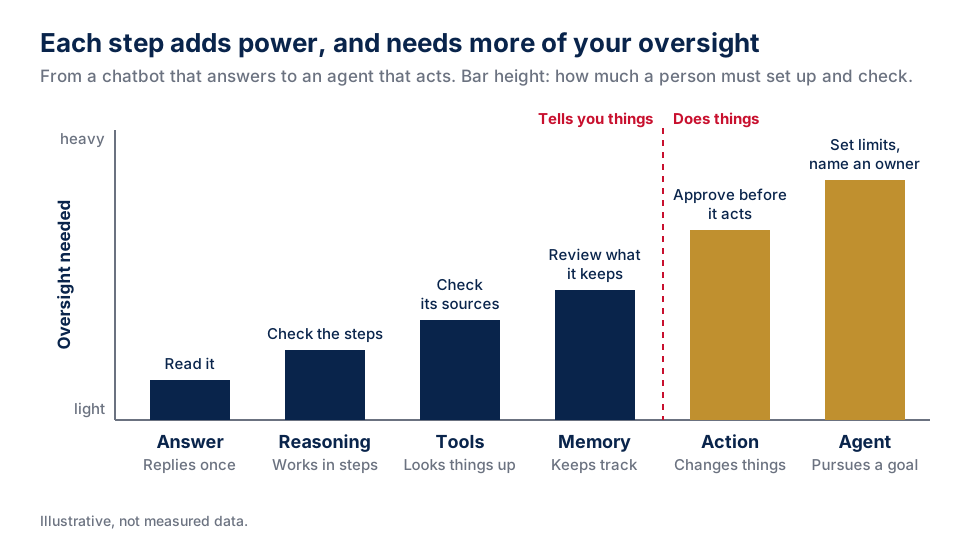
The line that matters most is between memory and action. Below it, the system tells you things and a person decides. Above it, the system does things, so your checks must be in place before it acts, not after.
People keep intent, judgement and accountability
None of this removes the manager. It changes the job. The system can search, compare, draft, track and repeat. People frame the question, judge the output, handle the cases that do not fit, and stay accountable for the decision.
Many organisations bolt a chatbot onto one step of an old process and expect a transformation. One step gets faster. The hand-offs and approvals stay the same. Value appears when the work itself is redesigned around what the system can now do. That is a bigger conversation than buying a tool.
On Monday, take one AI tool your team uses or is considering, and answer this on one page:
- What goal is it pursuing, in one sentence?
- What can it read, and what can it change?
- What must it never do?
- When does it stop and ask a person?
- Who is accountable for what it does?
If you cannot put a name on the last line, it is not ready for the action step.
Want to go further? Trusting a system that acts starts with knowing when to trust a single answer, and that is exactly where the free lesson begins.
Join the free 30-minute lesson, For Leaders: How Can AI Solve a Millennium Problem Yet Fail?, on Wednesday 21 October at 7pm London.
AI Transformation for Organisational Leaders is an eight-session live cohort I teach with Anoosh Zeighami, starting Wednesday 4 November. You leave with a one-page 2027 AI plan for your organisation.
AI Transformation for Organisational Leaders
For directors, heads of function and founders: eight live evening sessions with Ehsan Gazar and Anoosh Zeighami, ending with a one-page 2027 AI plan for your organisation, built on a real workflow and ready for your leadership team.
$1,495, or $1,045 with code EARLYBIRD until 23 Oct.
View the live cohortKeep reading
- Why AI Can Crack a 90-Year-Old Maths Problem and Still Get Your Invoice Wrong
- I Use AI Every Day: Why I Built a Place to Practise the Old Problems
- How I Find Problems Worth Solving
- Notes on Software Quality
- I Built a Tool to Compare Senior Engineer Salaries Across 17 Cities, and I Want Your Take
- MongoDB.local London 2025: AI, RAG, and the Future of Data