TypeScript Casting: A Powerful Tool for Type Safety
TypeScript casting — or more accurately, type assertions — lets you tell the compiler "I know more about this type than you do." It doesn't convert data a...
23 Apr 2024
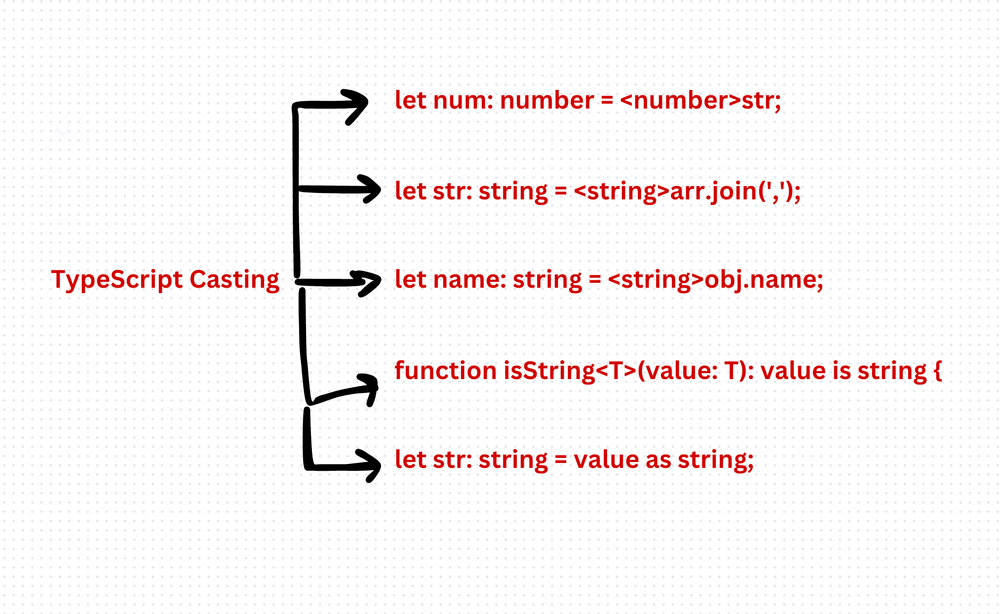
TypeScript casting — or more accurately, type assertions — lets you tell the compiler "I know more about this type than you do." It doesn't convert data at runtime. It overrides the compiler's judgment at compile time.
That distinction matters. A lot.
The as syntax
The most common form. You assert that a value is a specific type:
let value: any = 'hello';
let str: string = value as string;
This works because value is any. TypeScript trusts your assertion.
The angle bracket syntax
An older form that does the same thing:
let value: any = 'hello';
let str: string = <string>value;
Avoid this in JSX/TSX files — it conflicts with JSX syntax. Stick with as.
When casting makes sense
Casting is most useful when TypeScript can't narrow a type on its own. Common scenarios:
DOM elements:
const input = document.getElementById("search") as HTMLInputElement;
console.log(input.value);
TypeScript only knows getElementById returns HTMLElement | null. You know it's an input. The assertion bridges that gap.
API responses:
interface User {
  name: string;
  email: string;
}

const data = await fetch("/api/user").then(r => r.json()) as User;
Type guards as an alternative:
Instead of casting, you can use a type guard for runtime safety:
function isString(value: unknown): value is string {
  return typeof value === 'string';
}

let value: unknown = 'hello';
if (isString(value)) {
  console.log(value.toUpperCase()); // TypeScript knows it's a string
}
The trade-off
Casting lets you move fast when you know the type and TypeScript doesn't. That's the benefit.
The cost: you're bypassing the compiler. If you're wrong, TypeScript won't save you. The bug shows up at runtime, which is exactly what TypeScript is supposed to prevent.
My rule: use as sparingly. Prefer type guards when you can. And never cast to silence an error you don't understand — that's hiding a bug, not fixing one.
AI Transformation for Organisational Leaders
For directors, heads of function and founders: eight live evening sessions with Ehsan Gazar and Anoosh Zeighami, ending with a one-page 2027 AI plan for your organisation, built on a real workflow and ready for your leadership team.
$1,495, or $1,045 with code EARLYBIRD until 23 Oct.
View the live cohortKeep reading
- TypeScript Anti-Patterns That Cost You Twice: Build Time, Runtime, and the Interview
- The Frontend Toolchain Is Now Written in Rust and Go. What That Means for You
- oxlint vs ESLint: Why I Replaced ESLint with oxlint
- SystemJS Is Dead. Native ESM Finally Won.
- Replace Axios with a Simple Custom Fetch Wrapper (Production-Ready Guide)
- Stop Shipping ChatGPT Wrappers. Ship an Agent in TypeScript, or Don't Bother.