keyof in TypeScript
keyof takes a type and returns a union of its property names. That's it. One operator, but it unlocks some of the most useful patterns in TypeScript.
23 Apr 2024
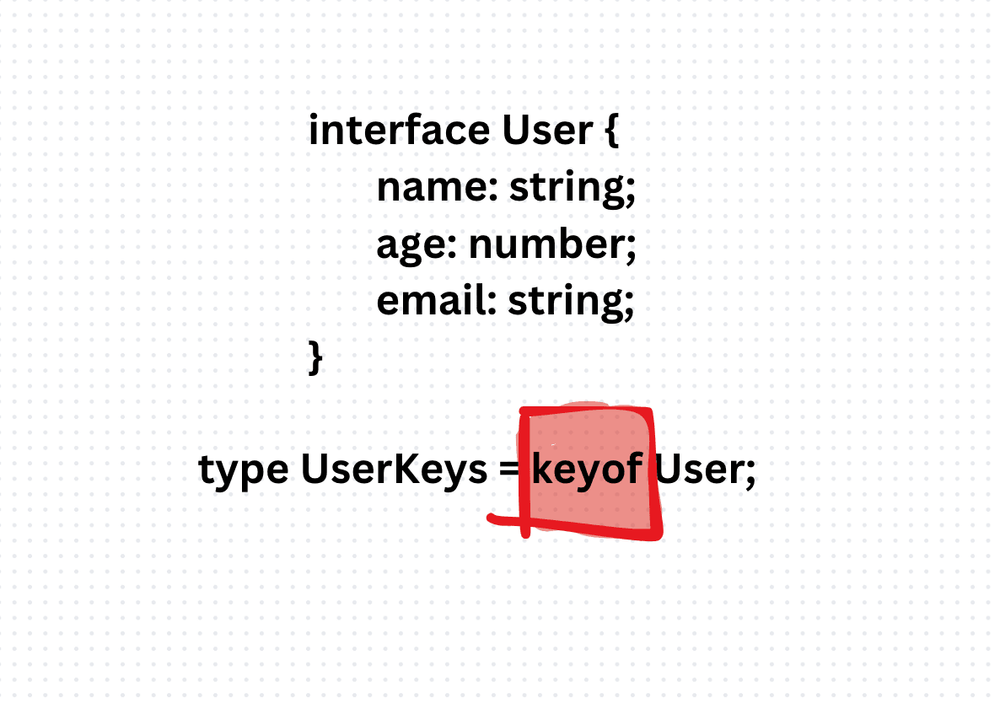
keyof takes a type and returns a union of its property names. That's it. One operator, but it unlocks some of the most useful patterns in TypeScript.
interface User {
  name: string;
  age: number;
  email: string;
}

type UserKeys = keyof User; // "name" | "age" | "email"
Why this matters
The real power shows up in generic functions. Say you want a function that reads a property from any object, but you want TypeScript to know the return type:
function getProperty<T, K extends keyof T>(obj: T, key: K): T[K] {
  return obj[key];
}

const user: User = { name: "Ehsan", age: 30, email: "ehsan@gazar.dev" };

const name = getProperty(user, "name"); // TypeScript knows this is a string
const age = getProperty(user, "age");   // TypeScript knows this is a number
getProperty(user, "foo");               // Compile error — "foo" is not a key of User
Without keyof, you'd use string as the key type and lose all type information about the return value.
Constraining function parameters
function processUser(user: { [key in keyof User]: any }) {}This ensures the function only accepts objects that have exactly the same keys as User, even if the value types differ.
The trade-off
keyof makes your types more precise. That's the benefit — fewer runtime surprises, better autocomplete, safer refactoring.
The cost: your type signatures become harder to read. Generic functions with multiple keyof constraints can look intimidating. If your teammates aren't comfortable with advanced TypeScript, simpler (less type-safe) approaches might be the better choice for your team.
I use keyof heavily in utility types and library code. In application code, I keep it simple unless type safety demands otherwise.
AI Transformation for Organisational Leaders
For directors, heads of function and founders: eight live evening sessions with Ehsan Gazar and Anoosh Zeighami, ending with a one-page 2027 AI plan for your organisation, built on a real workflow and ready for your leadership team.
$1,495, or $1,045 with code EARLYBIRD until 23 Oct.
View the live cohortKeep reading
- TypeScript Anti-Patterns That Cost You Twice: Build Time, Runtime, and the Interview
- The Frontend Toolchain Is Now Written in Rust and Go. What That Means for You
- oxlint vs ESLint: Why I Replaced ESLint with oxlint
- SystemJS Is Dead. Native ESM Finally Won.
- Replace Axios with a Simple Custom Fetch Wrapper (Production-Ready Guide)
- Stop Shipping ChatGPT Wrappers. Ship an Agent in TypeScript, or Don't Bother.