How to use Mount Stupid Concept for Leaders — Dunning-Kruger Effect and Imposter Syndrome?
One of the most useful mental models I've found for leading people is Mount Stupid. It changed how I read confidence in others -- and in myself.
15 Oct 2023

One of the most useful mental models I've found for leading people is Mount Stupid. It changed how I read confidence in others -- and in myself.
If you lead engineers, you need to understand where someone's confidence is actually coming from. Is it earned? Or is it the Dunning-Kruger effect talking?
What is Mount Stupid?
Start with the Dunning-Kruger Effect. It's a cognitive bias where people overestimate their knowledge in a specific area. Published in 1999 by David Dunning and Justin Kruger.
Here's what it means in practice: regardless of actual intelligence, we all unconsciously inflate our confidence. Society rewards certainty. So we perform it.
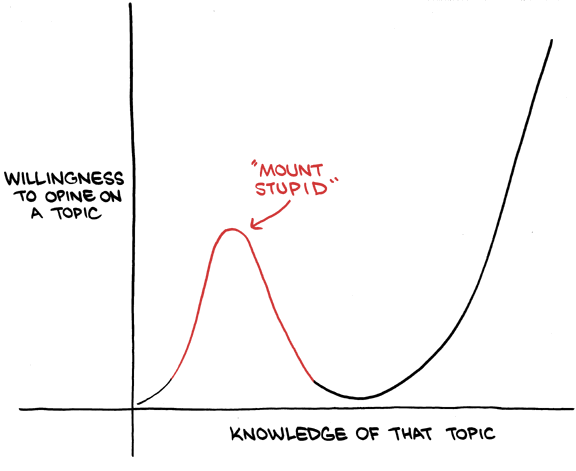
When someone starts learning a new topic, their confidence climbs fast. You'll hear things like:
- "This is easy. I don't know why that person gets paid so much for it."
- "This course was a waste. I could've learned it from 10 free articles."
- "I don't know why that expert does it that way. I could do it better."
Sound familiar? I've said versions of these myself early in my career.
The dangerous part: some people stop learning here. They sit on Mount Stupid for years, convinced they know enough.
Then reality hits. They execute a real project. They discover the ocean of things they don't know. Confidence crashes.
This doesn't mean they know less. It means they finally see how much more there is. You'll hear:
- "I don't know anything. There's so much I need to learn before I can even have an opinion."
- "Everyone knows more than me. I can't do anything right."
That's Imposter Syndrome. The feeling of incompetence despite evidence to the contrary.
Neither state -- Mount Stupid nor Imposter Syndrome -- reflects reality. But knowing where someone sits on this curve is a leadership superpower.
How I use this as a leader
Whether I'm interviewing, mentoring, or working with engineers daily, I'm always reading where someone's confidence is coming from.
They're at the beginning
Low confidence, genuine confusion about where to go next. They don't know what they don't know, and they feel it.
Guide them. Show them a path. Share resources. Introduce them to senior engineers who've walked the road.
Encourage them. They need it more than anything.
They're on Mount Stupid
Overconfident. Sometimes abrasive. They volunteer for responsibilities they can't handle because they genuinely believe they can.
Don't undermine them. They don't see it themselves.
Instead, expose them to complexity. Use technical vocabulary they should know but don't. Show them high-scale systems. Ask them to demonstrate their knowledge with results, not words.
They need to encounter what they don't know. That's the only way down from Mount Stupid.
They have Imposter Syndrome
They have results. A portfolio. Track record. But they say they don't know much. They downplay everything.
This is where you trust them publicly. Give them autonomy. Remove artificial pressure. Let them know you're not expecting them to move faster than others.
They're stressed. Your job is to reduce that stress by showing confidence in them -- even when they can't show it in themselves.
The takeaway
Understanding this curve changed how I delegate, how I interview, and how I coach engineers.
Some people need a push. Some need to be shown what they don't know. And others just need to be heard and trusted.
Sources:
AI Transformation for Organisational Leaders
For directors, heads of function and founders: eight live evening sessions with Ehsan Gazar and Anoosh Zeighami, ending with a one-page 2027 AI plan for your organisation, built on a real workflow and ready for your leadership team.
$1,495, or $1,045 with code EARLYBIRD until 23 Oct.
View the live cohortKeep reading
- Geek to Guru: Rocking the Tech World
- The Software Peter Principle: When Code Gurus Hit a Glitch:
- Cracking the Code: Understanding Demand in Your Job Market and Boosting Your Career
- I Built a Tool to Compare Senior Engineer Salaries Across 17 Cities, and I Want Your Take
- Software Engineering Job Search - Interview Process
- Exploring the Unknown: Unlocking Personal and Professional Growth