Service-Oriented Architecture (SOA) Design Pattern
I worked on a monolith that handled everything — user management, product catalog, order processing, payments, and email. Deploying a typo fix in the emai...
23 Mar 2024
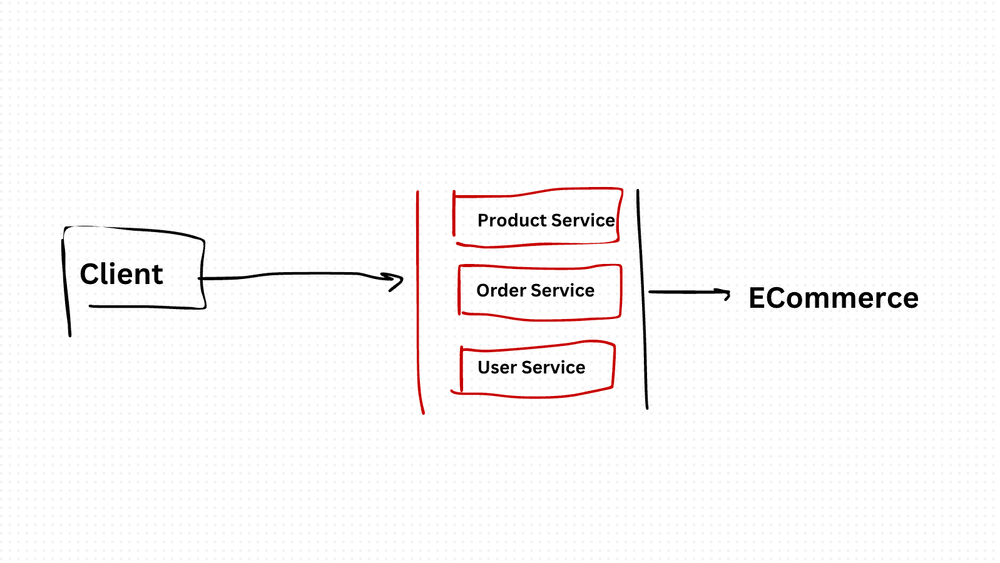
I worked on a monolith that handled everything — user management, product catalog, order processing, payments, and email. Deploying a typo fix in the email template required deploying the entire application. One failing payment endpoint brought down the product page. Everything was coupled.
Service-Oriented Architecture (SOA) breaks an application into independent services, each responsible for a specific business capability. Services communicate through well-defined interfaces — usually HTTP or message queues. Each service can be developed, deployed, and scaled independently.
Think of it like a shopping mall. Each store (service) runs its own business. The mall provides shared infrastructure (hallways, parking, security), but each store has its own inventory, staff, and hours. A problem in one store doesn't shut down the mall.
How I Think About Service Boundaries
For an e-commerce system, the split might look like:
- Product Service — Manages the catalog, inventory, pricing. Owns product data.
- Order Service — Handles order creation, status tracking, fulfillment coordination. Owns order data.
- User Service — Authentication, profiles, preferences. Owns user data.
- Payment Service — Processes charges, refunds, payment methods. Talks to external payment gateways.
- Notification Service — Sends emails, SMS, push notifications. Consumes events from other services.
Each service owns its data. The Product Service has its own database. The Order Service has its own. They don't share tables. If the Order Service needs product info, it calls the Product Service's API.
SOA vs. Microservices
SOA is the broader idea. Microservices are a specific style of SOA with smaller services, independent deployment pipelines, and a preference for lightweight communication (REST, gRPC, events). The principles are the same — loose coupling, high cohesion, service autonomy.
The Hard Parts
- Service boundaries. Get them wrong and you have a "distributed monolith" — all the complexity of microservices with none of the benefits. Boundaries should follow business capabilities, not technical layers.
- Data consistency. No shared database means no cross-service transactions. You need eventual consistency patterns — sagas, compensating transactions, or event-driven sync.
- Operational overhead. Each service needs its own deployment pipeline, monitoring, logging, and alerting. Five services means five times the ops work (at minimum).
- Network reliability. Services communicate over the network. Networks fail. You need retries, circuit breakers, timeouts, and graceful degradation.
The benefit: Independent deployment and scaling. Teams can own services end-to-end. Technology choices can differ per service. A failure in one service doesn't cascade to others (if done right).
The cost: Distributed systems are hard. Debugging spans multiple services. Latency increases with every network hop. And the organizational overhead is real — SOA works best when team structure matches service boundaries (Conway's Law).
I move to SOA when the monolith becomes a bottleneck for team velocity — when multiple teams are stepping on each other's code. For a small team building a single product, a well-structured monolith is simpler, faster, and easier to reason about. Split when you have a reason, not because it's trendy.
AI Transformation for Organisational Leaders
For directors, heads of function and founders: eight live evening sessions with Ehsan Gazar and Anoosh Zeighami, ending with a one-page 2027 AI plan for your organisation, built on a real workflow and ready for your leadership team.
$1,495, or $1,045 with code EARLYBIRD until 23 Oct.
View the live cohortKeep reading
- Event Sourcing Checklist: When It Makes Sense & Common Pitfalls
- Error Boundary React Design Pattern
- Context API React Design Pattern
- Higher-Order Component (HOC) React Design Pattern
- Container Component React Design Pattern
- Best Practices for Structuring Express.js Applications with Prisma Design Pattern