Word Pattern Algorithm
Given a pattern like "abba" and a string like "dog cat cat dog", check if the string follows the pattern. Each letter maps to exactly one word, and each w...
8 Apr 2024
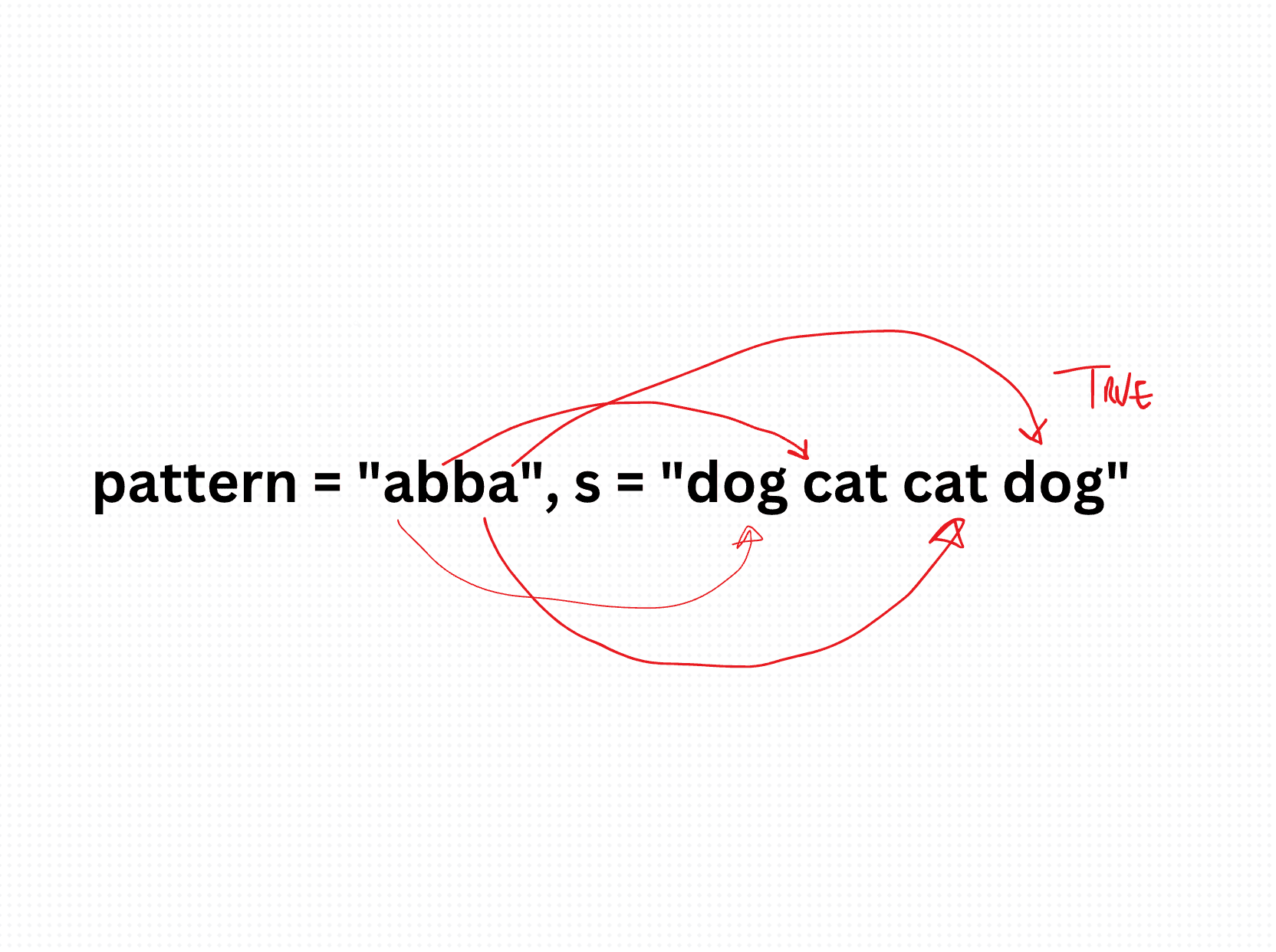
Given a pattern like "abba" and a string like "dog cat cat dog", check if the string follows the pattern. Each letter maps to exactly one word, and each word maps to exactly one letter. It's a bijection — a one-to-one, two-way mapping.
pattern = "abba", s = "dog cat cat dog" → true
pattern = "abba", s = "dog cat cat fish" → false
pattern = "abba", s = "dog dog dog dog" → false (a and b can't both map to "dog")
The intuition
You need two maps: one from pattern letters to words, one from words back to pattern letters. If a letter is already mapped to a different word, fail. If a word is already mapped to a different letter, fail. Both directions must agree.
Most people only check one direction and miss cases like "abba" → "dog dog dog dog".
var wordPattern = function(pattern, s) {
    const words = s.trim().split(' ');

    if (pattern.length !== words.length) return false;

    const letterToWord = new Map();
    const wordToLetter = new Map();

    for (let i = 0; i < pattern.length; i++) {
        const letter = pattern[i];
        const word = words[i];

        if (letterToWord.has(letter) && letterToWord.get(letter) !== word) return false;
        if (wordToLetter.has(word) && wordToLetter.get(word) !== letter) return false;

        letterToWord.set(letter, word);
        wordToLetter.set(word, letter);
    }

    return true;
};
Complexity
- Time: O(n) where n is the number of words/pattern characters.
- Space: O(n) for the two maps.
Why two maps?
A single map from letters to words can't catch the case where two different letters map to the same word. The reverse map enforces the bijection. This two-map pattern comes up any time you need to verify a one-to-one correspondence — isomorphic strings, cipher validation, symbol mapping.
AI Transformation for Organisational Leaders
For directors, heads of function and founders: eight live evening sessions with Ehsan Gazar and Anoosh Zeighami, ending with a one-page 2027 AI plan for your organisation, built on a real workflow and ready for your leadership team.
$1,495, or $1,045 with code EARLYBIRD until 23 Oct.
View the live cohortKeep reading
- The Algorithms Worth Knowing in Code Review: Cutting Big O Without Being Clever
- Tracking Down the Mystery: Finding the Unique Delivery ID
- Elusive Least Occurring Number in an Array
- Solving the Height of a Binary Tree Puzzle
- Harry Potter Discounts: A Code Challenge Algorithm
- Implementing a Task Heap Service in TypeScript