Maximum Subarray Algorithm
Given an array of integers, find the contiguous subarray with the largest sum.
12 Mar 2024
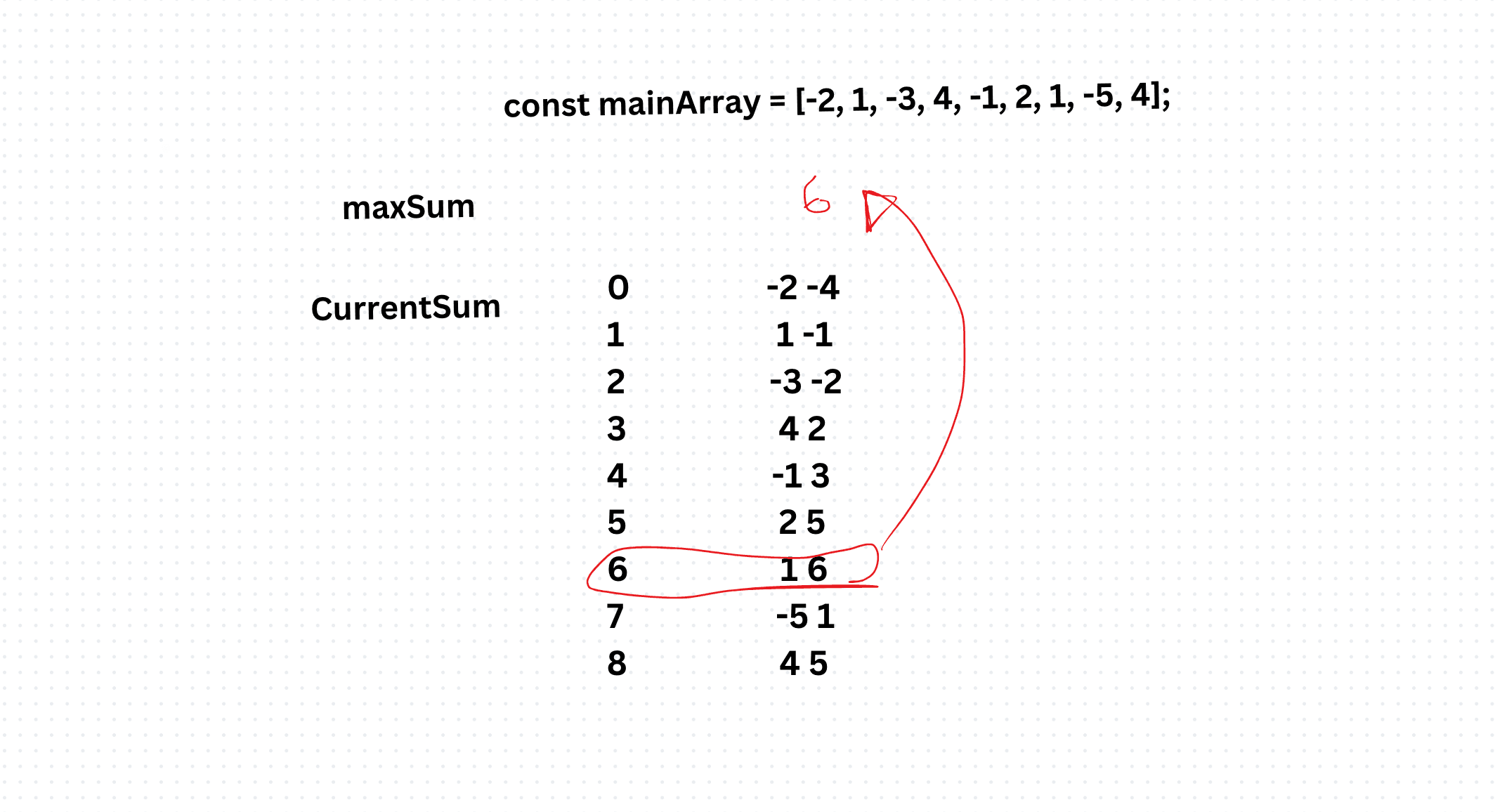
Given an array of integers, find the contiguous subarray with the largest sum.
Input: [-2, 1, -3, 4, -1, 2, 1, -5, 4]
Output: 6 (the subarray [4, -1, 2, 1])
The intuition
At each position, you face a simple decision: should the current element join the existing subarray, or start a new one?
If the running sum so far is negative, it's dragging you down. Drop it. Start fresh from the current element.
This is Kadane's Algorithm. One pass. One decision at each step.
The code
function maxSubArray(nums) {
    let currentSum = nums[0];
    let maxSum = nums[0];

    for (let i = 1; i < nums.length; i++) {
        currentSum = Math.max(nums[i], currentSum + nums[i]);
        maxSum = Math.max(maxSum, currentSum);
    }

    return maxSum;
}
How it works
Walk through the array. At each element, currentSum is either the element itself (starting fresh) or the element added to the running sum (extending the subarray). Track the best maxSum you've seen.
Other approaches
Brute force: Check every possible subarray. O(n^3) time. Terrible.
Divide and conquer: Split the array in half, solve each half, handle the crossing subarray. O(n log n) time. Better, but still not optimal.
Complexity
- Time: O(n) — single pass.
- Space: O(1) — two variables.
Trade-offs
Kadane's is elegant and optimal for the basic problem. But if you need the actual subarray indices (not just the sum), you'll need to track start and end positions, which adds a bit of bookkeeping. If the problem asks for maximum product instead of sum, the approach needs modification since negative times negative is positive.
Production-Ready Systems with LLMs and Agents
A live Maven cohort, 5 October to 2 November: eight 90-minute sessions where you build LLM and agent systems that survive real traffic, real cost and real failure. Tuesdays and Thursdays, 7:30 to 9:00pm London.
Cohort 2 starts 5 October. Eight live sessions, $1,500.
View the live cohortKeep reading
- The Algorithms Worth Knowing in Code Review: Cutting Big O Without Being Clever
- Tracking Down the Mystery: Finding the Unique Delivery ID
- Elusive Least Occurring Number in an Array
- Solving the Height of a Binary Tree Puzzle
- Harry Potter Discounts: A Code Challenge Algorithm
- Implementing a Task Heap Service in TypeScript